What Is a VTOL Drone and Why Is It Changing Industrial Aerial Operations?
A VTOL Drone gives industrial operators a more practical way to work in the field.
Traditional fixed-wing aircraft are efficient over long distances, but they usually need more space for takeoff and landing. Multirotor drones are easier to launch in tight areas, but their shorter endurance can limit performance on larger missions.
A VTOL Drone combines the strengths of both.
It takes off and lands vertically like a multirotor, then transitions into fixed-wing flight for better range, efficiency, and coverage. For industrial users, that means easier deployment without giving up the flight performance needed for serious operations.
Built for Real Field Conditions
Industrial aerial work rarely happens in ideal environments.
Operators often need to launch from uneven ground, narrow roadsides, mountain areas, utility corridors, or emergency scenes. In these situations, a platform must do more than fly well on paper. It needs to deploy quickly, adapt to real site conditions, and complete longer missions with fewer limitations.
That is why the VTOL Drone is becoming a preferred choice across industrial applications.
Why a VTOL Drone Is a Better Fit for Industrial Missions
A VTOL Drone solves two common operational problems at the same time:
limited launch space
insufficient range from conventional multirotor platforms
By combining vertical takeoff with fixed-wing forward flight, it gives operators more flexibility on the ground and more efficiency in the air.
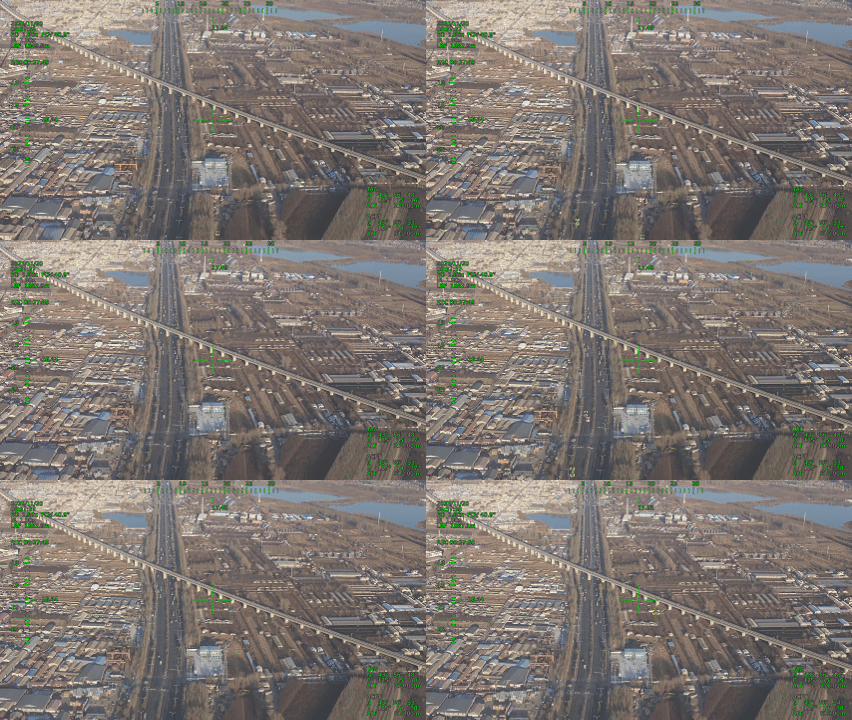
This makes it especially useful for missions that require:
long route coverage
fast field deployment
stable flight in demanding conditions
support for specialized payloads
Typical Applications of a VTOL Drone
Infrastructure Inspection
A VTOL Drone is well suited for long inspection routes such as power lines, pipelines, rail corridors, forestry routes, and water conservancy systems.
These missions often involve remote terrain and limited launch areas. A platform that can launch vertically and still maintain efficient forward flight helps operators cover more ground with fewer interruptions.
According to the source text, BOXIANG’s dual fixed-wing systems are used in applications including power line inspection, forestry and utility operations, water conservancy inspection, and pipeline patrol.
Mapping and Surveying
Large-area surveying demands more than simple flight capability. It requires efficiency, stability, and payload compatibility.
A VTOL Drone can improve sortie productivity by reducing the number of takeoffs, landings, and battery changes needed to complete wide-area work.
The source material states that BOXIANG supports mapping cameras, oblique camera systems, multispectral sensors, and LiDAR modules for surveying and data collection tasks.
Security and Monitoring
For perimeter patrol, wide-area observation, and long-duration monitoring, staying airborne longer creates real operational value.
A VTOL Drone can provide broader coverage than a standard multirotor while still remaining flexible at the deployment site. With visible-light and thermal payload options, it becomes even more effective for surveillance and monitoring missions.
Emergency Response
Emergency situations often involve restricted access, limited launch space, and urgent response demands.
A VTOL Drone helps teams launch quickly and gain situational awareness across a wider area. The original text also highlights disaster reconnaissance and emergency communication relay as relevant use cases.
Why BOXIANG’s Dual Fixed-Wing Platform Stands Out
Chang Chun Chang Guang Bo Xiang UAV Co., Ltd. has developed dual fixed-wing UAV platforms around practical field needs. The original article describes the company as focusing on endurance, payload capacity, wind resistance, portability, and mission flexibility, with technical support linked to the UAV Division of the Chinese Academy of Sciences.
Endurance for Longer Missions
Longer endurance helps reduce interruptions and improve operational efficiency. For industrial users, that means fewer mission breaks and better route completion capability.
Stable Flight for Demanding Environments
Stable flight and wind resistance matter in real-world aerial work. They affect safety, image quality, data consistency, and overall reliability.
Rapid Deployment in the Field
Transport convenience and quick deployment are important when crews need to move fast. A UAV that is easier to carry, assemble, and launch reduces friction before the mission even begins. The source text specifically emphasizes compact structure, transport convenience, and quick deployment.
Flexible Payload Integration
Payload flexibility is what turns an aircraft into a useful industrial platform.
Based on the original draft, BOXIANG offers payload options including visible-light imaging, thermal imaging, zoom observation, laser ranging, full-frame mapping cameras, oblique systems, multispectral sensors, and LiDAR modules.
That allows one platform family to support multiple mission types, from inspection and monitoring to mapping and emergency response.
What to Consider When Choosing a VTOL Drone
The right VTOL Drone should match the real mission, not just the spec sheet.
Before choosing a platform, buyers should consider:
mission range
launch site conditions
required payload type
endurance needs
environmental conditions
deployment speed
operational safety features
The original text also notes return-to-home, low-battery return, and signal-loss protection as important safety functions.
Final Thoughts
A VTOL Drone is changing industrial aerial operations because it removes a major operational compromise.
It allows teams to launch from constrained sites while still achieving the flight efficiency of a fixed-wing platform. That makes it a smarter choice for inspection, surveying, monitoring, patrol, and emergency response.
For industrial users, the value is clear: more flexibility, better coverage, and stronger mission efficiency in real field conditions.