
Winged Drones, Explained: Why Dual Fixed-Wing VTOL Flies Farther, Smarter, and Safer
Why Winged Drones Outlast Rotor-Only Designs
Endurance is a ratio game: lift per unit drag and energy turned into forward motion. Rotors dominate takeoff/landing and precise low-speed work; wings start paying the moment you accelerate. Dual fixed-wing VTOL wins by combining both without wasting power during the hand-off.
How Wings Turn Lift Into Range
Once you’re wing-borne, lift comes from pressure differentials over airfoils—not from constantly accelerating air downward. That shift slashes power draw for a given weight, so more of your energy moves you forward instead of merely keeping you up. Pair clean aerodynamics with sensible wing loading and you unlock mission legs that change how often you launch, recover, and recharge.
Cruise vs. Hover: Where the Energy Goes
Hover is expensive because thrust must equal weight continuously. In cruise, the wing carries weight and propulsion only needs to overcome drag. That’s why fixed-wing VTOL dominates wide-area mapping, corridor inspection, patrol routes, and other hour-scale missions—where efficiency beats vertical “tricks.”
Design Rules That Preserve VTOL Endurance
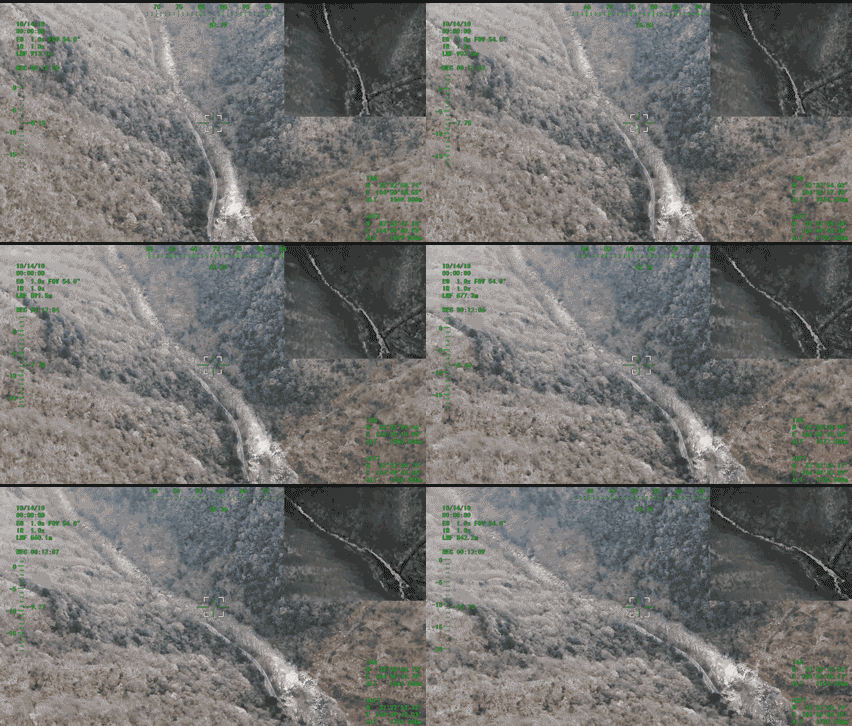
Transition: Unload Rotors, Load Wings—Smoothly
Most endurance is won (or lost) in seconds. During “tilt and accelerate,” rotor downwash can blanket the wing. Good control laws time acceleration to clear the wing quickly, and smart geometry keeps prop vortices off sensitive surfaces. Dual-wing layouts share load as the aircraft rotates to cruise, taming pitch coupling and shortening transition distance.
CG, Wing Loading, and Stall Margin
A centered center of gravity (CG) and reasonable wing loading minimize trim drag and protect stall margin. Dual-wing geometry broadens the CG box, helping the aircraft handle mixed payloads gracefully without burning energy in constant trim.
Power Budget: Think in Wh per Kilometer
Minutes per battery misleads. Track watt-hours per kilometer. Every gram of drag—antennas, exposed gear, even fastener heads—adds up over long sorties. Dual-wing VTOLs spend briefly at high power to lift off, then settle into miserly cruise for the majority of the mission.
Airframe Architecture That Buys Time Aloft
Dual Fixed Wings vs. Single Wing: What the Second Wing Actually Does
The second wing isn’t a novelty; it spreads lift, reduces per-wing loading, and enables shorter spans without sacrificing lift. You get better low-speed handling during transition and steadier cruise at survey speeds—which you feel as lower energy per km and calmer sensor platforms.
Rotor Placement, Downwash, and Interference Drag
Place a lift rotor too close to a wing and you pay twice: interference drag and reduced control margin in turbulent inflow. A careful layout keeps lift rotors clear of cruise surfaces and routes wiring and pylons inside fairings for cleaner transitions and less yaw-roll coupling in gusts.
Control Surfaces and Gust Rejection
Endurance isn’t just battery math. Correctly sized ailerons/elevons at the mission Reynolds numbers plus high-authority VTOL controls let the autopilot reject gusts quickly instead of chasing energy-wasting oscillations.
Payloads as “Aero Passengers,” Not Just Weight
EO/IR, LiDAR, and Ranging—Shaping the Flight Envelope
Our dual fixed-wing VTOL platforms integrate EO/IR and LiDAR suites delivering 4K imaging, up to 240× hybrid zoom, and laser ranging to 3,000 m. These capabilities expand altitude options and stand-off safety, but they must be budgeted for drag, mass, and electrical power from day one.
Pods, Pylons, and Fairings: Small Shapes, Big Effects
A smooth pod and tidy pylon can buy meaningful minutes. Fairings reduce separation, while isolation mounts protect sensors from rotor-induced vibration in hover. Keep heavy optics close to CG to limit trim drag, and shield connectors from the slipstream.
Data Quality vs. Flight Time: Finding the Sweet Spot
Overspec the sensor and you overspend energy; underspec it and you’ll need repeat flights. Start from the required data product (GSD, SNR, point density), then back-solve altitude and ground speed to select optics/LiDAR that hit the target with modest power draw.
Autonomy and Safety Systems That Protect Endurance
Redundancy, Health Monitoring, and Fault Response
Endurance without resilience is wishful thinking. Dual power buses, cross-checked IMUs, and rotor-out contingency logic prevent nuisance faults from becoming forced landings. The practical promise is consistent: keep flying, keep sensing, get home.
BVLOS, C2 Links, and Smart Return-to-Base
Long legs demand rock-solid C2 and return logic that respects wind, terrain, and reserves. Certified behaviors aren’t mere paperwork—they avoid diversions and aborts that waste energy and time.
Where Endurance Pays Off
Wide-Area Mapping and Corridor Inspection
Straighter survey lines, cleaner airflow over sensors, and fewer launch cycles. Our fixed-wing VTOL series is built for forestry, utilities, water conservancy, long pipelines, and transmission corridors—the use cases that reward hours, not minutes.
Middle-Mile Logistics and Emergency Response
In mountains, jungle, or dense cities, vertical access meets efficient cruise to keep the schedule. Long-range missions and emergency response benefit directly from low Wh/km and high wind margins.
Defense ISR and Patrol
Persistent stare and timely arrival rarely coexist—unless you can launch vertically and cruise efficiently. Dual fixed-wing VTOL provides both.
Why CHANG CHUN CHANG GUANG BO XIANG UAV Co., Ltd. Leads
Born from deep technical heritage, CHANG CHUN CHANG GUANG BO XIANG UAV Co., Ltd. (Changguang Boxiang) operates as a modern, production-scale manufacturer focused on dual fixed-wing VTOL systems for civilian and defense programs.
Airframe, Payload, and Manufacturing Advantages
Our platforms are engineered for long endurance, high payload capacity, strong wind resistance, maneuverability, and portability—all direct outcomes of the aerodynamic and systems discipline described above. Payload options span EO/IR and LiDAR with extreme zoom and long-range laser ranging, enabling high-altitude mapping and stand-off ISR without compromising data quality.
Certifications, Facilities, and Program Support
A maturity marker: TW50 (≈10 kg payload, ~300 km range) and TW200 (50 kg payload, ~400 km range) earned CAAC Special Airworthiness Certification with zero corrections. We operate an 8,000+ m² R&D and production facility with dedicated flight-testing airspace—exactly what you want behind an endurance-first platform.
Buying Guide: A Spec Checklist That Goes Beyond Brochures
Conclusion
Endurance isn’t magic—it’s a stack of disciplined choices: clean aerodynamics, precise transition, matched payloads, and robust systems. Dual fixed-wing VTOL gives you vertical access when you need it and wing-borne efficiency when you don’t. That’s the promise we build toward every day: long-legged aircraft that handle real weather, carry real sensors, and come home with the data that matters.
FAQs
1) What’s the single biggest lever for endurance?
Airframe cleanliness in cruise. A clean planform and well-faired payload pod often save more energy than a modest battery upgrade.
2) How can I tell if transition is efficient?
Ask for flight logs. Look for short, repeatable transition distances and stable pitch/roll traces showing smooth rotor unloading and wing loading with minimal oscillation.
3) Do I need dual wings for every mission?
Not always. Dual wings shine for varied payloads, rough air, and wide CG margins. For short hops with light sensors, well-designed single-wing VTOL can still perform.
4) How do I size sensors without killing flight time?
Start from the required data product (GSD, SNR, point density). Back-solve altitude and ground speed, then choose optics/LiDAR that meet specs with modest electrical draw. Keep the pod near CG and fair it properly.
5) Which certifications should I look for?
National/regional airworthiness approvals, documented reliability metrics, and a clear BVLOS playbook. These correlate strongly with endurance you can actually use.