Stability Isn’t a Buzzword: What “Stable Hover + Efficient Cruise” Really Means for a UAV Surveillance Drone
If you’ve ever watched a live feed almost freeze on the exact detail you needed—then drift, jitter, and turn certainty into “maybe”—you already get it: stability isn’t a feature, it’s the foundation.
As a dual fixed-wing VTOL UAV manufacturer, we look at stability the way operators experience it: not as a brochure claim, but as the difference between seeing and guessing. And in surveillance work, guessing burns time, increases risk, and forces teams into bad decisions.
Why “stability” is a mission outcome, not a marketing word
People often describe a UAV surveillance drone as “stable” because it looks calm in the sky. That’s not the test.
Real stability shows up as outcomes you can feel during a shift:
Cleaner identification at high zoom (less micro-shake, less blur)
More reliable tracking (fewer “lost target” moments during retask)
Better map confidence (your cues land where they should, not “somewhere around there”)
Lower operator fatigue (less constant correcting, fewer mental spikes)
In short: stability isn’t the headline—it’s what makes the headline true.
Most surveillance missions have two personalities
Nearly every real-world sortie splits into two very different jobs:
The close-in moment: hover or slow loiter while you confirm, zoom, range, and track.
The long-distance grind: cruise efficiently to reposition, cover area, or hold station without draining your day in one short burst.
A UAV surveillance drone that’s great at one and mediocre at the other forces you into compromises:
A steady view that can’t stay up long enough to matter, or
Endurance that falls apart exactly when you need a clean look.
That’s why “stable hover + efficient cruise” isn’t a slogan in our world—it’s a practical requirement.
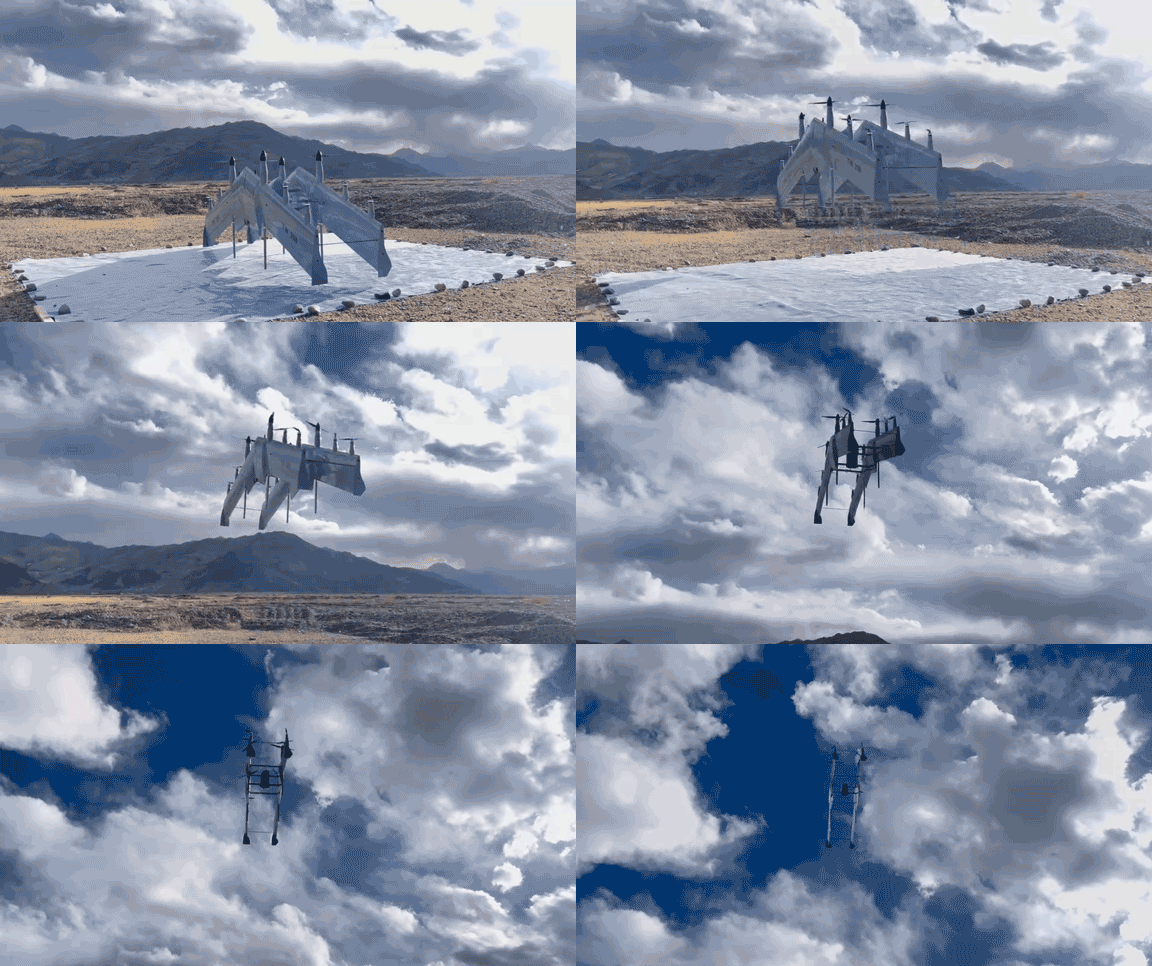
Stable hover: the moment your drone gets judged
Hover is where the truth comes out.
When the call comes—“Can you confirm that?”—you’re typically zoomed in, time-constrained, and one shaky frame away from doubt.
Stable hover is not just “not drifting.” It’s quiet control:
Minimal oscillation
Predictable yaw behavior (no overshoot + hunting)
Enough wind tolerance that the aircraft doesn’t look like it’s arguing with the atmosphere
If hover stability requires heroic piloting, it’s not stability—it’s a talent show.
A fast hover-stability checklist you can use in any demo
No lab coat needed—just run these:
High-zoom hold: does the feed “swim,” or stay readable?
Yaw stop: when you rotate, does it stop cleanly or wobble back and forth?
Wind behavior: does it hold position calmly, or drift-correct-drift-correct?
Pilot workload: calm hands—or constant nudging?
Efficient cruise: the part teams underestimate (until they can’t ignore it)
Cruise can look “easy,” so it’s easy to undervalue. But cruise efficiency is what turns surveillance from “a short look” into “professional coverage.”
Efficient cruise means wing-borne performance that helps you:
Move to the next point without wasting energy
Loiter longer without “battery panic”
Keep the payload usable (not just flying fast)
Maintain dependable control + video links over distance
Think of it like a good road trip car: top speed is nice, but what you really care about is mileage, comfort, and fewer stops.
Cruise isn’t about speed. It’s about staying useful.
If you’re comparing systems, look beyond “how fast it goes” and ask:
How long can it stay on-station with a working payload?
How stable is the navigation path (especially on repeatable routes)?
What happens to the mission when the air gets rough?
How clean is the transition between hover and forward flight?
Transition quality: where “stable hover” and “efficient cruise” either connect—or collide
VTOL gives you flexibility, but transitions are where many platforms “leak stability.”
A good UAV surveillance drone should transition in a way that:
Doesn’t drop the target during mode changes
Doesn’t spike workload at the worst time
Keeps the payload output usable (not chaotic) while the aircraft changes states
If the aircraft becomes “busy” during transition, your operators become busy too—and that’s how mistakes get invited into the mission.
The payload is the truth serum (it will expose instability)
Want the fastest, most honest evaluation of stability?
Don’t start with the airframe. Start with the payload output.
High-zoom EO, thermal edges, and ranging overlays don’t hide platform weakness—they amplify it. Micro-motion becomes macro-annoyance.
That’s why stability should be evaluated with the sensor package you actually plan to use:
High zoom (does detail stay legible?)
Thermal contrast boundaries (does jitter get worse?)
Ranging / target positioning overlays (does drift degrade confidence?)
Stability has three layers: airframe, control, and workflow
A lot of “stability” conversations stop at aerodynamics. That’s only one layer.
From an operator’s point of view, stability is a stack:
Airframe stability: structure, layout, vibration behavior
Control stability: how disturbances are handled; how the aircraft holds attitude and position
Workflow stability: how quickly operators can plan, retask, and act without friction
You can have a stable aircraft and still get unstable outcomes if the workflow is chaotic—especially under pressure.
The enemy isn’t only wind—it’s workload
Wind is obvious. Workload is sneakier.
During real surveillance operations, tasks pile up:
Pilot monitoring and decision-making
Sensor operator zoom/range/tracking
Radio / coordination
Logging / reporting / handoffs
If your UAV surveillance drone requires constant babysitting, it steals attention from the mission. So when we talk about “operator-first” design, what we really mean is: stability includes the human system.
Why dual fixed-wing VTOL changes the stability trade-off
Multirotors can hover beautifully—but often pay for it with endurance.
Classic fixed-wing aircraft cruise efficiently—but demand launch/landing space.
Dual fixed-wing VTOL exists to reduce the “either/or”:
Vertical access when you need it
Wing-borne efficiency when you need endurance and coverage
One platform that can arrive, observe, and stay—without forcing teams into constant compromise
A field playbook for repeatable stability (the stuff that actually works)
Here’s what strong teams do—regardless of platform brand:
Plan smooth routes near the observation area
Aggressive turns invite corrections, and corrections show up as jitter.Treat hover like a measurement
When confirming a target, reduce inputs and let the system settle. Your best input may be none.Transition on purpose
VTOL is a superpower, not a fidget toy. Switch modes when it adds value, not because it’s available.Make handoffs explicit
If you have a pilot + sensor operator: “I’m steady; you’re on zoom.” Clear roles reduce conflicting inputs.
Evaluation questions you can steal for your next demo
Use these to force real answers:
Show high-zoom hover in wind. What happens when conditions aren’t polite?
Show hover-to-cruise transition while keeping a target in frame.
Show what the operator sees: map + video + core telemetry without menu hunting.
Show how payload swaps work: time from “case closed” to “mission ready.”
Show safety behavior: signal loss, navigation anomalies, low battery—what happens and how clearly is it communicated?
Conclusion
Stability isn’t a buzzword because surveillance isn’t a brochure scenario. It’s wind, fatigue, time pressure, and fleeting moments that don’t come back.
“Stable hover + efficient cruise” is a simple promise:
Stay steady when precision matters, then move and loiter efficiently so the mission doesn’t end early.
That’s how a UAV surveillance drone becomes a tool teams can trust—not just a platform that looks good on paper.
FAQs
1) What’s the quickest way to judge stability in a demo?
Zoom in, hold hover, and watch micro-motion. High zoom tells the truth fast.
2) Why does cruise efficiency matter if I mostly hover for surveillance?
Because most missions are “reposition + observe” loops. Cruise efficiency determines how long you can keep the mission alive.
3) Do payload specs affect perceived stability?
Yes. Better optics/thermal/ranging make tiny movement more obvious—strong payloads reveal instability.
4) What ground station info matters most in real operations?
The basics that prevent surprises: wind, battery, signal quality, map position, and a clean live feed.
5) How does dual fixed-wing VTOL help vs. pure multirotor?
It reduces the trade-off: vertical access for tight sites plus wing-borne efficiency for longer coverage.