
What Is a VTOL Drone?
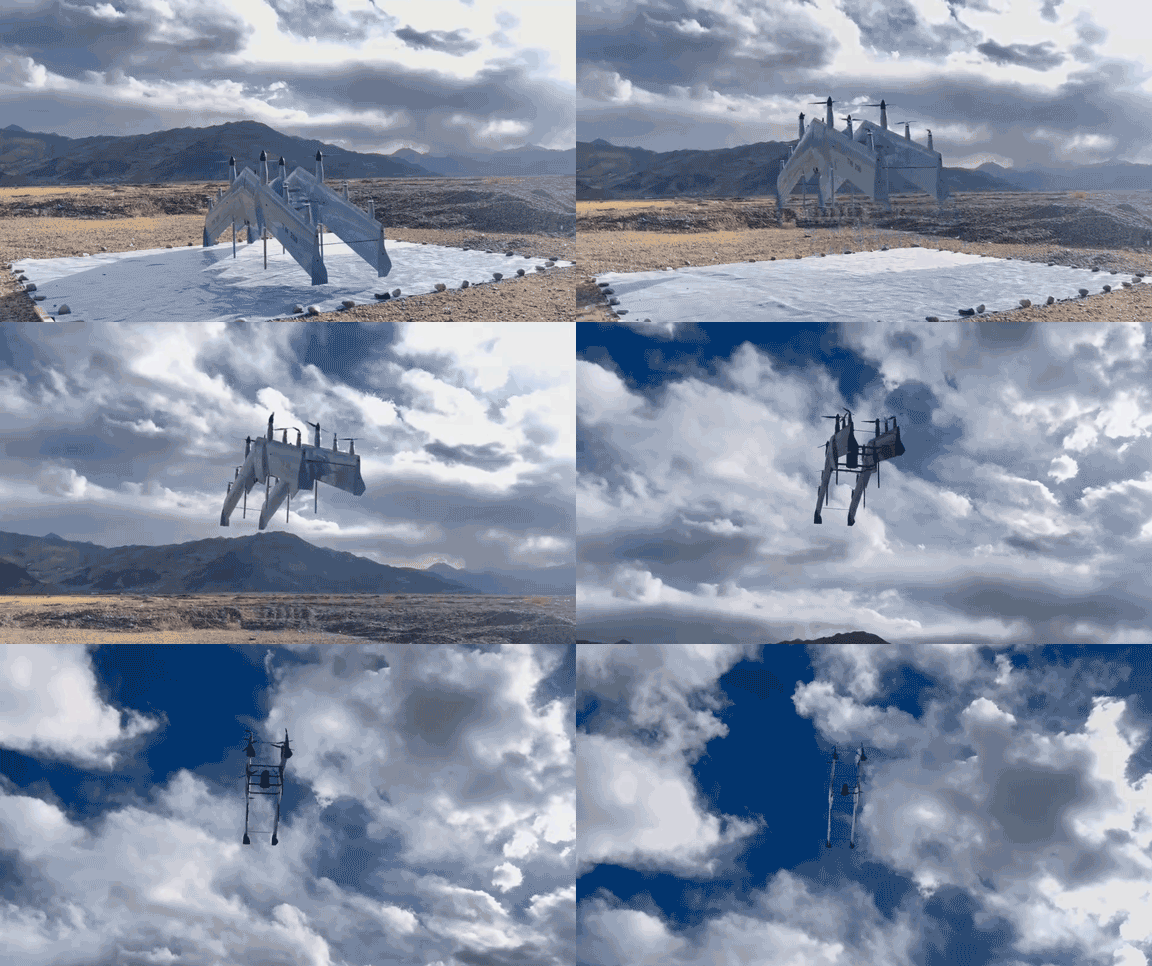
A VTOL drone is an unmanned aircraft that can take off and land vertically without requiring a runway, catapult, or recovery net.
Some VTOL drones use rotors throughout the entire flight. Others, known as fixed-wing VTOL UAVs, take off vertically and then transition into efficient wing-borne cruise. This second type combines the flexible deployment of a multirotor with the range and efficiency of a fixed-wing aircraft.
For industrial operators, this combination can solve two common problems:
Limited space for takeoff and landing
Insufficient endurance for long routes or large areas
That makes fixed-wing VTOL platforms especially useful for mapping, infrastructure inspection, environmental monitoring, emergency response, security patrol, communication relay, and other professional missions.
What Does VTOL Mean?
VTOL stands for Vertical Takeoff and Landing.
A VTOL aircraft can rise vertically from a relatively small area and descend vertically at the end of the mission. It does not need the conventional takeoff run used by many airplanes.
However, VTOL describes the takeoff and landing capability—not the complete aircraft configuration.
VTOL aircraft may include:
Multirotor drones
Fixed-wing VTOL drones
Tilt-rotor aircraft
Tail-sitter UAVs
Lift-and-cruise aircraft
Dual-wing VTOL platforms
Hybrid-electric or fuel-powered VTOL aircraft
This distinction is important because different VTOL designs have different strengths.
A multirotor is well suited to hovering and close-range maneuvering. A fixed-wing VTOL UAV is generally more suitable when the mission involves long routes, wide areas, higher cruise speeds, or extended flight time.
What Is a Fixed-Wing VTOL UAV?
A fixed-wing VTOL UAV combines two flight systems in one aircraft.
It can:
Take off vertically using lift rotors
Accelerate and transition into forward flight
Use its wings to generate lift during cruise
Return to vertical flight before landing
Land without a prepared runway
The basic flight sequence is:
Vertical takeoff → transition → fixed-wing cruise → return transition → vertical landing
During vertical flight, the propulsion system must generate enough thrust to support the aircraft’s weight. During forward cruise, airflow over the wings produces most of the lift, allowing the aircraft to travel more efficiently.
This is why fixed-wing VTOL platforms are often selected for missions that require both runway independence and long-distance coverage.
Understanding Common UAV Terms
Several different phrases are used to describe similar aircraft.
Searchers may use terms such as:
Fixed wing VTOL UAVs
VTOL fixed wing UAV
Fixed wing UAV
VTOL UAV drone
Airplane UAV
Winged drones
These terms are related, but they are not always identical.

Fixed Wing UAV
A fixed wing UAV uses wings to generate lift during forward flight. A conventional fixed-wing UAV may require a runway, catapult, hand launch, parachute, net, or belly landing system.
Not every fixed-wing UAV has vertical takeoff and landing capability.
VTOL Fixed Wing UAV
The phrase “VTOL fixed wing UAV” normally describes an aircraft that combines vertical takeoff and landing with fixed-wing cruise.
It is another word order commonly used for a fixed-wing VTOL UAV.
VTOL UAV Drone
“VTOL UAV drone” is a broad phrase that may refer to either a multirotor or a fixed-wing VTOL aircraft. Buyers should confirm the aircraft configuration instead of relying on the name alone.
Airplane UAV
An airplane UAV usually refers to an unmanned aircraft with airplane-style wings. Some airplane UAVs require conventional launch and recovery equipment, while others include VTOL capability.
Winged Drones
Winged drones are unmanned aircraft that use one or more fixed lifting surfaces during forward flight. The category includes conventional fixed-wing aircraft, tilt-rotor UAVs, tail-sitters, and fixed-wing VTOL systems.
How Does a Fixed-Wing VTOL Drone Work?
A typical mission can be divided into four main phases.
1. Vertical Takeoff
The lift rotors raise the aircraft vertically from the launch area.
This phase requires relatively high power because the propulsion system is supporting the aircraft without significant lift from the wings.
Vertical takeoff allows deployment from locations such as:
Narrow roadsides
Forest clearings
Mountain areas
Ship decks
Industrial sites
Building roofs
Disaster areas
Temporary field bases
2. Transition to Forward Flight
After reaching a safe height, the aircraft accelerates.
As airspeed increases, the wings begin carrying more of the aircraft’s weight. The flight-control system gradually reduces reliance on the vertical-lift motors and transfers control to the cruise propulsion system and aerodynamic surfaces.
A suitable transition should be:
Stable
Short
Repeatable
Energy-efficient
Free from excessive pitch or roll movement
Transition quality is an important part of fixed-wing VTOL design. Poorly controlled transitions may create unnecessary drag, consume additional energy, reduce altitude margins, or affect payload data.
3. Wing-Borne Cruise
Once the aircraft reaches the required airspeed, the wings provide most of the lift.
The cruise motor mainly needs to overcome aerodynamic drag and maintain forward speed. This normally requires less energy per kilometer than continuous rotor-supported flight.
Most of the range and endurance advantage of a fixed-wing VTOL UAV is created during this phase.
4. Vertical Landing
Near the recovery point, the aircraft slows down and transfers lift back to the vertical propulsion system.
It can then descend vertically and land within a relatively small area without following a conventional runway approach.
Fixed-Wing VTOL vs Multirotor vs Conventional Fixed Wing
Multirotors remain the better choice for tasks that require prolonged hovering, close structural inspection, indoor operation, or precise low-speed movement.
Conventional fixed-wing aircraft can be highly efficient when a suitable runway, launch system, or recovery area is available.
Fixed-wing VTOL UAVs are most useful when the mission requires efficient forward flight but the deployment site cannot support conventional fixed-wing operations.
Why Do Winged Drones Usually Fly Farther?
The main difference is how lift is produced.
A multirotor must continuously use motor power to support its full weight, even while hovering in one place. When it moves forward, the propulsion system still needs to produce vertical thrust.
During fixed-wing cruise, airflow over the wings generates lift. The propulsion system mainly provides forward thrust to overcome drag.
This can reduce the energy required per kilometer and make winged drones more suitable for:
Power lines
Pipelines
Railways
Highways
Forests
Coastlines
Agricultural land
Border corridors
Large construction areas
Wide disaster zones
The advantage is greatest when the aircraft spends most of its mission in efficient cruise and only a limited amount of time hovering or flying vertically.
Published endurance should still be treated carefully. Actual performance depends on payload weight, wind, altitude, temperature, cruise speed, battery or fuel capacity, reserve requirements, and aircraft configuration.
Five Main Advantages of Fixed-Wing VTOL UAVs
1. Runway-Free Deployment
Traditional fixed-wing UAVs may require a runway, launcher, recovery net, parachute, or open landing area.
A fixed-wing VTOL aircraft can operate from a much smaller site. This reduces dependence on prepared infrastructure and lets teams deploy closer to the actual mission area.
2. Efficient Long-Route Coverage
Wing-borne cruise can reduce energy consumption per kilometer.
This may allow operators to:
Cover larger areas in one sortie
Follow longer inspection routes
Reduce battery changes
Reduce launch and recovery cycles
Spend less time relocating the aircraft
Improve field productivity
Actual endurance must always be confirmed with the required payload and an appropriate operational reserve.
3. Flexible Payload Integration
Professional UAV missions often require more than a standard camera.
Fixed-wing VTOL systems may carry:
Visible-light cameras
Zoom EO cameras
Thermal or EO/IR gimbals
Mapping cameras
Oblique camera systems
LiDAR
Multispectral sensors
Hyperspectral sensors
Laser rangefinders
Methane detectors
Communication relay equipment
Emergency lighting
Small cargo modules
Payload compatibility depends on weight, dimensions, power consumption, data interface, mounting position, aerodynamic drag, vibration, and center of gravity.
4. Better Suitability for Wide-Area Operations
Fixed-wing aircraft can follow planned routes at a relatively stable airspeed and altitude.
This is valuable for applications such as mapping, corridor inspection, forestry, coastal monitoring, and patrol, where consistent coverage matters more than prolonged hovering.
Stable flight can also support better image overlap, sensor alignment, and repeatable data collection.
5. Flexible Field Transport and Setup
Many professional VTOL platforms use modular components such as:
Detachable wings
Folding propellers
Quick-release payload mounts
Swappable batteries
Portable ground control stations
Protective transport cases
A practical field design can reduce assembly time, simplify transportation, and make payload changes easier.
Buyers should verify the real deployment procedure instead of relying only on statements such as “portable” or “rapid setup.”
What Is a Dual-Wing VTOL UAV?
A dual-wing or tandem-wing VTOL UAV uses two primary lifting surfaces rather than one conventional main wing.
When properly designed, a dual-wing layout may help:
Distribute lift across a compact airframe
Increase useful lifting area
Support low-speed control
Maintain control authority during transition
Accommodate different payload positions
Support a wider center-of-gravity range
Reduce transportation length
Improve field portability
However, a second wing does not automatically guarantee longer endurance, higher payload, or better wind resistance.
Real performance also depends on:
Total wing area
Wing loading
Aerodynamic drag
Structural weight
Propulsion efficiency
Flight-control tuning
Transition behavior
Payload installation
Center of gravity
Weather conditions
Operators should evaluate the complete aircraft rather than choosing a platform based only on its wing configuration.
Common VTOL Drone Payloads
The correct payload should be selected according to the result the mission needs to produce.
Payload integration affects more than the total aircraft weight.
It can change:
Center of gravity
Aerodynamic drag
Electrical consumption
Vibration
Flight endurance
Maximum altitude
Mission speed
Data-link requirements
Cooling requirements
For this reason, payload testing should be completed on the actual aircraft configuration.
Main Applications of VTOL UAV Drones
Mapping and Surveying
Fixed-wing VTOL aircraft can cover long flight lines while maintaining relatively consistent speed and altitude.
Typical payloads include mapping cameras, oblique cameras, multispectral sensors, and LiDAR.
Applications include:
Land surveying
Construction mapping
Mining measurement
Corridor mapping
Terrain modeling
Agricultural mapping
3D city modeling
Infrastructure Inspection
Long linear assets benefit from efficient cruise.
Typical targets include:
Power lines
Pipelines
Railways
Roads
Rivers
Water conservancy systems
Coastal infrastructure
Vertical takeoff allows the aircraft to launch close to the inspection route, even where a runway is unavailable.
Agriculture and Forestry
A VTOL UAV drone can carry RGB, thermal, multispectral, or LiDAR sensors for:
Crop monitoring
Plant-stress assessment
Irrigation analysis
Pest detection
Forest inventory
Vegetation management
Fire-risk monitoring
Environmental Monitoring
Wide-area environmental missions may include:
Forest monitoring
Wetland surveys
Coastline inspection
Reservoir monitoring
Wildlife observation
Water-quality support
Disaster assessment
Longer route coverage can reduce the number of deployment points required in difficult terrain.
Emergency Response
After floods, fires, earthquakes, landslides, or other emergencies, suitable launch areas may be limited.
Fixed-wing VTOL systems may support:
Rapid mapping
Thermal search
Damage assessment
Route reconnaissance
Communication relay
Emergency lighting
Small supply delivery
Security and Patrol
With suitable EO/IR, zoom, or laser-ranging payloads, winged drones may support:
Border patrol
Perimeter monitoring
Maritime observation
Forest patrol
Industrial-site security
Wide-area public-safety operations
Mission planning must account for communication coverage, return reserve, weather, terrain, and applicable aviation regulations.
Offshore and Maritime Operations
Runway-free deployment can be useful for work near coastlines, offshore facilities, ports, and vessels.
Potential missions include:
Offshore wind inspection
Oil and gas infrastructure monitoring
Shipping-lane observation
Coastal mapping
Maritime search and rescue
Communication relay
Ship-deck operation requires additional evaluation of wind, movement, salt exposure, recovery procedures, and crew safety.
Remote Logistics and Communication Relay
A fixed-wing VTOL UAV may carry medical supplies, spare parts, food, emergency equipment, or communication payloads across remote routes.
Cargo missions require careful consideration of payload volume, loading access, center of gravity, release method, landing options, and regulatory requirements.
Electric vs Hybrid Fixed-Wing VTOL UAVs
Electric and hybrid systems serve different mission requirements.
Electric VTOL UAV
Electric platforms are generally suitable when operators prioritize:
Simpler field operation
Lower vibration
Lower routine maintenance
Quick battery replacement
Shorter or medium-duration missions
Hybrid VTOL UAV
Hybrid-powered platforms may be considered when the mission requires:
Longer endurance
Greater route coverage
Heavier payloads
Reduced dependence on battery-only energy
Extended operation in remote areas
The right power system depends on payload, endurance, field support, maintenance capacity, environmental conditions, and mission frequency.
Safety and Mission Planning Considerations
Long endurance is useful only when the aircraft can complete the mission safely and return with an appropriate reserve.
Important functions may include:
Automated preflight checks
Low-energy warnings
Return-to-home logic
Lost-link response
Alternate landing planning
Battery or fuel monitoring
Propulsion monitoring
GNSS anomaly detection
Geofencing
Flight-data recording
Fault alerts
Redundant navigation sensors
Wind limits should be confirmed separately for:
Vertical takeoff
Transition
Cruise
Return transition
Vertical landing
Cruise wind capability may be higher than the safe wind limit for takeoff or landing.
For long-range or BVLOS operations, teams should also evaluate airspace rules, communication planning, operator approvals, emergency procedures, detect-and-avoid requirements, and aircraft certification where applicable.
How to Choose the Right VTOL Drone
The largest aircraft or the model with the longest published endurance is not automatically the best choice.
Start with the mission requirement.
Ask the manufacturer for performance data under realistic conditions, including:
Actual payload
Cruise speed
Wind
Temperature
Altitude
Route profile
Reserve policy
Takeoff and landing procedure
BOXIANG Dual Fixed-Wing VTOL Platforms
CHANG CHUN CHANG GUANG BO XIANG UAV Co., Ltd., also known as BOXIANG UAV, develops electric and hybrid dual-wing fixed-wing VTOL platforms for industrial and specialized missions.
The company’s work includes:
UAV platform development
Electric and hybrid power systems
Payload integration
Ground control systems
Flight-control development
Customized mission configurations
Field deployment support
BOXIANG platforms can be configured for mapping, inspection, monitoring, emergency response, environmental work, communication relay, and other applications.
Because performance varies by aircraft model and payload, buyers should review the specifications and test data for the exact configuration being considered.
Frequently Asked Questions
What is a VTOL drone?
A VTOL drone is an unmanned aircraft that can take off and land vertically. Some VTOL drones use rotors throughout the flight, while fixed-wing VTOL drones transition into efficient wing-borne cruise.
Is a VTOL drone the same as a multirotor?
No. A multirotor is one type of VTOL drone. Fixed-wing VTOL aircraft also take off vertically but use wings during forward cruise.
Is every fixed wing UAV a VTOL aircraft?
No. Many conventional fixed-wing UAVs require a runway, launcher, parachute, net, or another recovery system.
Does a fixed-wing VTOL UAV need a runway?
No. It can take off and land vertically from a relatively small operating area.
Can fixed-wing VTOL UAVs hover?
They can hover during vertical flight phases. However, prolonged hovering is generally less energy-efficient than wing-borne cruise and may not be the main purpose of the aircraft.
Why do fixed-wing VTOL UAVs usually fly farther than multirotors?
During cruise, the wings generate most of the lift. The propulsion system mainly overcomes drag instead of continuously producing all the lift required to support the aircraft.
What payloads can a VTOL drone carry?
Depending on the aircraft model, payloads may include visible-light cameras, EO/IR gimbals, mapping cameras, LiDAR, multispectral sensors, laser rangefinders, communication equipment, and cargo modules.
What affects the real endurance of a VTOL drone?
Important factors include payload weight, aerodynamic drag, battery or fuel capacity, wind, altitude, temperature, cruise speed, vertical-flight time, and required return reserve.
Should I choose a multirotor or fixed-wing VTOL UAV?
Choose a multirotor for close-range work, prolonged hovering, and precise low-speed inspection. Choose a fixed-wing VTOL platform when the mission requires long routes, wide-area coverage, runway-free deployment, or greater cruise efficiency.
Conclusion
A VTOL drone removes the need to choose between flexible field deployment and efficient forward flight.
Fixed-wing VTOL UAVs can take off from constrained sites, transition into wing-borne cruise, cover long routes, carry specialized payloads, and land vertically near the mission area.
The most suitable platform depends on the complete mission—not on a single specification. Buyers should compare payload performance, endurance with reserve, transition stability, communication range, weather limits, safety logic, deployment requirements, and after-sales support before selecting an aircraft.
For mapping, infrastructure inspection, environmental monitoring, emergency response, security patrol, or remote logistics, a properly configured fixed-wing VTOL UAV can provide a practical balance of range, flexibility, and field efficiency.
Get a Recommended VTOL UAV Configuration
Share your mission route, required payload, operating environment, endurance target, and deployment location with BOXIANG to identify a suitable electric or hybrid VTOL platform.