
Long Range Drones for Sale for National Border Security
Border protection today is less about fences on a map and more about staying ahead of fast-moving, hard-to-see risks. Smugglers, illegal crossings, and emergency incidents can appear anywhere along hundreds or thousands of kilometers of terrain—often at night, often far from roads or airstrips.
If you’re comparing long range drones for sale for national border security, the real question is simple:
Which “patrol aircraft” gives the most coverage, the clearest picture, and the lowest risk and cost over time?
More and more agencies are reaching the same conclusion: dual fixed-wing VTOL UAVs are becoming the core platform for serious border missions. At CHANG CHUN CHANG GUANG BO XIANG UAV Co., Ltd. (BOXIANG UAV), our dual-wing VTOL drones are designed exactly for this kind of sustained, real-world border work.
From Static Lines to Dynamic Aerial Shields
Why traditional border setups are no longer enough
For decades, border security relied on a familiar toolkit:
Fences and physical barriers
Checkpoints and inspection stations
Guard towers and ground patrols
Occasional sorties by manned aircraft
These measures still matter, but they are fundamentally static. They protect where infrastructure exists—and only when people are there to operate it. Meanwhile, threats now move faster and in more directions:
Vehicles pushing through remote tracks
Boats cutting across coastal or river borders
Small UAVs trying to bypass ground defenses
Rapid shifts in migration flows due to policy or conflict
You simply can’t place personnel everywhere, 24/7.
Static barriers vs. moving aerial “searchlights”
A fence is like a locked door: effective, but only at a fixed line. A long-endurance UAV patrol acts more like a moving searchlight sweeping the entire border zone. It ignores terrain obstacles—ravines, rivers, cliffs, forests—and keeps watching from above.
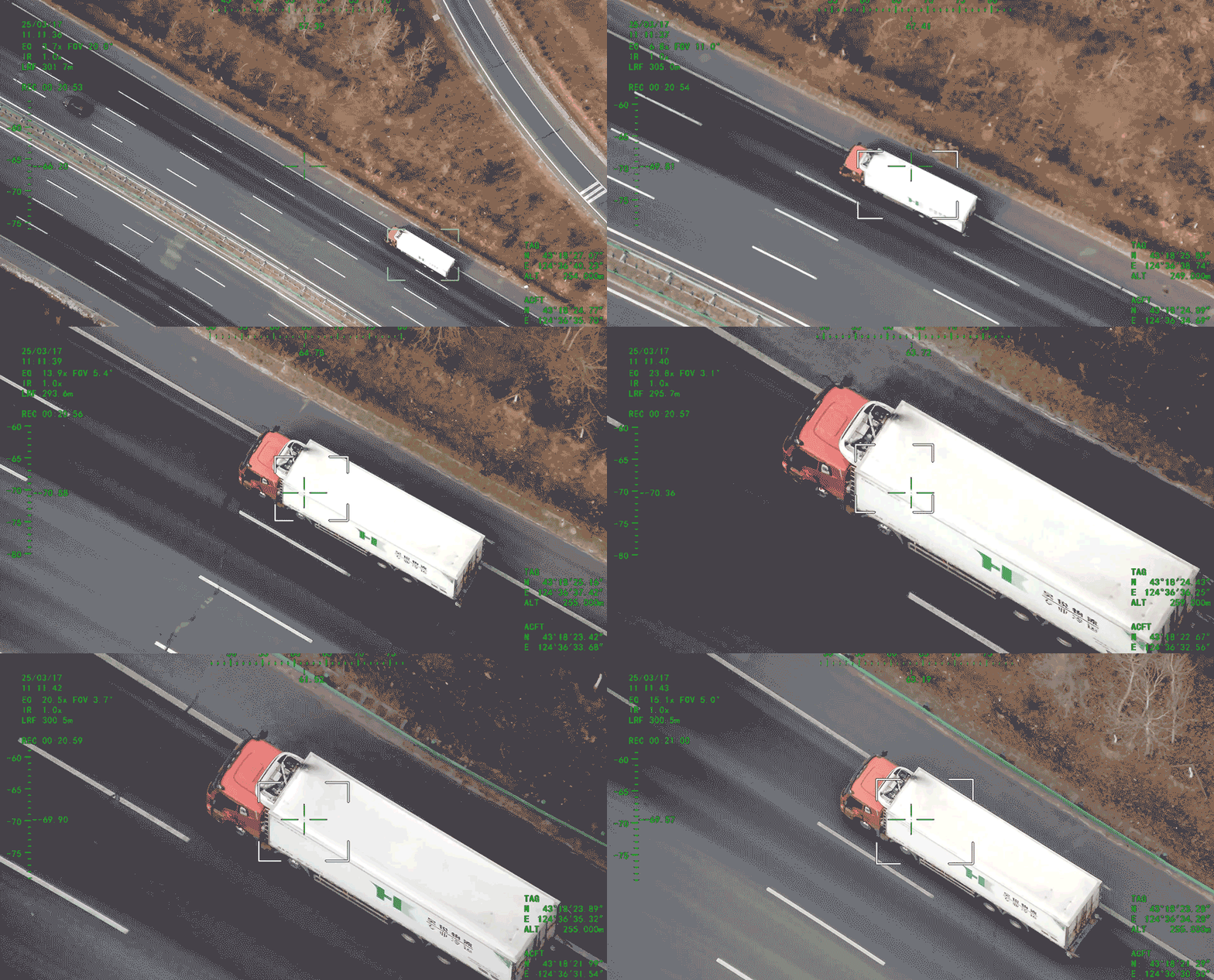
Equipped with high-zoom EO/IR payloads, one aircraft can:
Scan wide swaths of terrain in a single flight
Zoom in on suspicious activity in real time
Record 4K video and thermal imagery with georeferenced data
Commanders don’t have to guess what happened later—they can replay exactly where, when, and what was seen.
Why ground patrols alone fall behind
Ground teams remain essential. They intercept, search, rescue, and investigate. But without aerial coverage, they are mostly reacting to partial information:
They see only what’s visible from roads, tracks, and shorelines
Hidden approach routes and staging points remain invisible
Night operations over open terrain become guesswork
Long-endurance drones close this gap by offering a constant top-down view. Instead of aimless loops, patrols are guided by live intelligence—sent to the right place at the right moment.
What “Long Range Drones for Sale” Really Need to Deliver
When agencies look up long range drones for sale, they are not thinking about hobby aircraft. They’re evaluating airborne systems that must:
Stay airborne for hours, not minutes
Fly tens or hundreds of kilometers from launch
Carry serious EO/IR, mapping, or communication payloads
Operate from rough, improvised sites with minimal ground support
Short-flight multirotors are excellent for quick checks—a vehicle stop, a small hillside, a riverside inspection—but they cannot hold a pattern all night over a remote valley.
Dual fixed-wing VTOL UAVs change the baseline. BOXIANG’s dual-wing VTOL family offers:
Wingspans from compact backpackable models to 5.94 m-class aircraft
MTOW from around 7 kg up to 200 kg
Unladen endurance of up to 8 hours, with multi-hour endurance even under EO/IR loads
That’s the difference between “we checked once this evening” and “this corridor has been under continuous watch since sunset.”
Dual Fixed-Wing VTOL vs Other Long Range Drones for Sale
Most long range drones for sale fall into two basic categories:
Multirotors – Vertical takeoff and landing, easy to fly, but limited endurance and range
Pure fixed-wing UAVs – Efficient in cruise, but dependent on runways, catapults, or nets
Dual fixed-wing VTOL UAVs merge these worlds.
What makes dual fixed-wing VTOL different
BOXIANG’s design adopts a dual-wing (tandem) layout with multiple rotors and full-vector control:
Two wings share lift and stabilize the airframe
VTOL rotors handle vertical takeoff and landing
The aircraft transitions automatically into efficient fixed-wing cruise
In practice, operators get:
Vertical takeoff and landing from small, uneven sites
Efficient cruise at 60–90 km/h, ideal for wide-area patrols
Vertical recovery back to a base, vehicle, or improvised pad
For border forces, that means launching from:
Remote outposts and mobile command vehicles
Dirt roads, clearings, and temporary camps
Locations where building a runway is simply not realistic
Why Dual Fixed-Wing VTOL Becomes the New Patrol Aircraft
On paper, dual fixed-wing VTOL sounds like an elegant design choice. In the field, it solves daily operational headaches.
VTOL convenience with fixed-wing endurance
The dual-wing + multi-rotor architecture is engineered for:
High payload capacity
Long endurance
Stable behavior in strong winds
Crews don’t need nets, catapults, or long strips. They:
Assemble the airframe quickly
Run an automatic self-check
Launch vertically with a single command
Once airborne, the drone transitions into efficient, wing-borne flight and flies preplanned routes or dynamic tasking from the command center.
All-terrain launch and recovery
Many borders cross unforgiving terrain:
High mountains and plateaus
Deserts and scrublands
Marshes, wetlands, and dense forests
Long, exposed coastlines
As long as there is enough space to stand up the aircraft and clear the rotors, operators have a launch site. Smaller models ride in backpacks or SUVs; larger ones travel in flight cases on pickups or light trucks.
This mobility makes it far easier for agencies to reposition airborne surveillance assets as routes and threat patterns shift.
BOXIANG UAV: Technical Depth Behind the Airframe
CHANG CHUN CHANG GUANG BO XIANG UAV Co., Ltd. is not a short-term startup. The team originates from the UAV division of the Chinese Academy of Sciences (founded in 2009) and has been transformed into an innovation-driven enterprise since 2021, operating an 8,000+ m² R&D and production facility with dedicated test airspace.
For border agencies, that background matters. You are not only buying today’s aircraft—you are investing in a platform and partner that can scale and evolve.
Core performance parameters for national missions
Across the BOXIANG dual fixed-wing VTOL series, you’ll find:
Payload capacity: ~7–200 kg
Endurance: up to 8 hours unladen
Wind resistance: up to Beaufort scale level 8 in cruise
Positioning: RTK-level accuracy (≈1 cm + 1 ppm)
Control / link range: typically 50–100 km on larger models
This combination means:
Fewer sorties to cover the same border sector
Larger patrol boxes per aircraft
Reliable flights even when weather is less than ideal
Payloads: Turning a Drone into a Border Intelligence Platform
A bare airframe is just a flying wing. What matters for border agencies is the payload ecosystem. BOXIANG’s platforms support a wide range of mission sensors tailored to border and security scenarios.
Day–night EO/IR pods for long-distance detection
Standard EO/IR gimbals (120× / 240× series) combine:
4K visible-light imaging (up to 3840 × 2160)
Powerful optical and hybrid zoom (up to 240×)
Infrared channels (e.g., 640 × 512) for thermal detection
This lets operators:
Scan wide valleys, canyons, and coastlines
Zoom in on vehicles or small groups for identification
Capture stabilized, high-quality video evidence in gusty conditions
Laser ranging for exact target coordinates
Tri-sensor payloads with laser rangefinders measure distances from tens of meters up to several kilometers:
Operators can tag exact coordinates on the map
Ground units receive precise positions instead of vague descriptions
Multi-agency response becomes faster and more coordinated
Mapping, LiDAR, and communication modules
Beyond surveillance, dual fixed-wing VTOL platforms from BOXIANG support:
Full-frame nadir and oblique cameras for high-resolution mapping
LiDAR sensors for corridor and terrain modeling
Multispectral cameras for environmental monitoring along borders
Airborne communication relay modules for extending radio coverage
Illuminators and voice broadcast modules for search and crowd guidance
For border agencies, that means one fleet can support both security and civil missions—without buying separate systems.
Real-World Border Scenarios
Wide-area surveillance and pattern-of-life
Along a remote border sector with few outposts, crews can:
Launch a dual fixed-wing VTOL from a dirt track
Climb to patrol altitude
Fly multi-hour routes across key corridors
Over days and weeks, analysts build a pattern-of-life picture:
Normal traffic routes and timings
Frequently used tracks and crossing points
Baseline activity for each region
When something deviates from this baseline—a convoy at unusual hours, groups assembling in quiet areas—it is immediately obvious.
Counter-smuggling and illegal crossings
With EO/IR and laser ranging, aircraft can:
Detect small groups or vehicles under low light
Confirm what they are and how they are moving
Record evidence with timestamped coordinates
Ground units are then directed to specific locations, reducing blind searches and improving the quality of legal evidence afterward.
Disaster, rescue, and crisis support
Border regions often suffer from:
Floods and landslides
Wildfires and storms
Infrastructure failures and communication outages
The same long range drones for sale that handle surveillance can pivot to:
Disaster mapping and damage assessment
Fire perimeter monitoring and hotspot detection
Emergency communication relay over affected towns
Rapid delivery of medical or relief payloads
Budgets invested in UAVs thus serve both security and civil protection roles.
From Single Aircraft to Networked Fleets
One dual fixed-wing VTOL is useful. A coordinated fleet is transformational.
Multi-UAV relay in difficult RF and GNSS environments
BOXIANG platforms are designed with multi-UAV collaboration in mind:
One aircraft can fly as a communication relay node
Others push deeper into valleys or canyons
Live video and telemetry keep flowing even with limited ground infrastructure
This architecture is particularly valuable in:
“Triple-disruption” situations—power, signal, and network degradation
Mountainous borders where line-of-sight is broken
Post-disaster environments where towers are damaged
Integration into existing border command systems
When you evaluate long range drones for sale, integration is every bit as important as endurance. BOXIANG systems are built to:
Fly autonomous routes and ad-hoc missions
Stream real-time video and map overlays
Feed telemetry into established C2 platforms
Operators see UAV feeds alongside ground sensors, radars, and legacy systems in a single operational picture—no need to reinvent the whole command stack.
Safety, Reliability, and All-Weather Operation
Border work doesn’t pause for bad weather or minor technical problems. Safety logic and robustness determine whether a fleet is truly usable.
Intelligent failsafes
BOXIANG dual fixed-wing VTOL UAVs incorporate safety features such as:
GNSS anomaly handling across multiple satellite constellations
Automatic return-to-home on link loss
Low-battery protection and auto-return logic
Fast self-checks before launch
These functions help reduce the risk of losing aircraft and keep operations safe even in complex RF environments.
Wind and environment tolerance
According to published specs, BOXIANG platforms can:
Operate in temperatures roughly from –20°C to +65°C
Handle light rain
Resist winds up to Beaufort level 6 during VTOL phases and up to level 8 in cruise on larger models
For borders that see winter storms, desert heat, or strong coastal winds, this translates to fewer “no-fly days” and more consistent situational awareness.
Cost and Logistics: Doing More with Smaller Teams
Compared with manned patrol aircraft, dual fixed-wing VTOL UAVs dramatically reduce:
Pilot risk—no one is in the cockpit
Infrastructure requirements—no full airbase or runway
Per-sortie fuel and maintenance costs
Portable systems vs runway-bound patrol aircraft
Where manned aircraft demand long runways and hangars, BOXIANG UAVs:
Pack into backpacks, flight cases, or small trucks depending on model
Launch vertically from clearings, dirt roads, or temporary pads
Allow a small crew to manage multiple aircraft on rotation
Even relatively small border units can maintain persistent aerial coverage over priority sectors without massive infrastructure investments.
Choosing Long Range Drones for Sale for Harsh Border Environments
When you evaluate long range drones for sale for national border work, it helps to go beyond brochure claims.
Non-negotiable technical criteria
Key factors to put at the top of your checklist:
Endurance & range – Multi-hour flights and tens of kilometers of control/relay range
Payload flexibility – EO/IR, laser ranging, LiDAR, mapping cameras, comm relays on one platform
Wind & weather performance – Documented wind resistance and temperature range
Navigation & safety – GNSS redundancy, RTK precision, robust failsafes
Operational simplicity – Quick assembly, fast self-checks, one-click VTOL launch
Evaluating vendors beyond the spec sheet
Long-term success depends on the manufacturer’s depth and support. BOXIANG UAV brings:
Roots in the Chinese Academy of Sciences with more than a decade of R&D
Experience across civilian industries and defense-related missions
Certifications (e.g., GJB9001C, ISO9001:2015) and recognition as a “Specialized, Refined, Distinctive, and Innovative Enterprise” in Jilin Province
Focus on training, after-sales service, and customization for specific sectors
This becomes especially important when scaling from pilot projects to nationwide deployment.
How BOXIANG UAV Supports Border and Security Agencies
BOXIANG does more than ship airframes. For border and security customers, the company acts as a long-term capability partner.
Support typically spans the full lifecycle:
Joint requirement analysis and system configuration
Pilot and payload-operator training
Integration with existing IT and command platforms
Ongoing maintenance, upgrades, and mission-specific tuning
Instead of delivering a standalone drone, BOXIANG helps agencies build a scalable border surveillance system that can evolve with threats and policy.
Looking Ahead: The Future of Border Patrol UAVs
Today’s dual fixed-wing VTOL UAVs already provide a step change in coverage and efficiency. The next wave of development is pushing further.
Smarter autonomy and assisted detection
Future systems will:
Automatically flag unusual movement or patterns in live video
Highlight objects or behaviors that match risk profiles
Help operators manage more aircraft and more data without overload
AI-assisted analytics will allow small teams to handle large fleets.
Deeper integration with ground, air, and space assets
Border monitoring is moving toward multi-layered sensing, merging:
UAV feeds
Satellite imagery
Ground radar and acoustic sensors
Cross-border or multi-agency data where applicable
Dual fixed-wing VTOL UAVs with flexible payload bays and robust communication architectures are well positioned to sit at the center of this integrated picture.
Conclusion: Turning Borders into Intelligent Perimeters
On the map, borders are lines. In reality, they are vast, dynamic spaces filled with people, vehicles, goods, and sometimes emergencies. Ground-heavy approaches alone are too slow and too expensive to keep up.
For agencies seriously comparing long range drones for sale for national border security, dual fixed-wing VTOL UAVs from BOXIANG UAV offer a different model:
Long-endurance patrol aircraft that launch from almost anywhere
Powerful multi-sensor payloads for day–night detection and mapping
Strong wind resistance and all-weather adaptability
Seamless integration into existing command systems
Instead of a static fence, you get an intelligent, aerially monitored perimeter—flexible, persistent, and ready to adapt as threats and missions change.