The best drones with longest range for real search and rescue
When people talk about the best drones with longest range, search and rescue (SAR) is usually the first mission profile that comes to mind. Time, coverage, and reliability decide whether a missing person is found in time, and traditional tools like helicopters can’t always be everywhere at once.
As a dual fixed-wing VTOL UAV manufacturer, we design BOXIANG platforms specifically to stretch that “survival window”: stay in the air longer, see farther, and give commanders a clear picture of the entire search area—not just a few hundred meters around the launch point.
Why the best drones with longest range matter in modern SAR
Time, coverage, and survival odds
Every SAR mission is a race between:
how long a victim can stay alive, and
how quickly teams can scan the relevant terrain.
Helicopters help, but they’re expensive to deploy, limited by availability, and often constrained by terrain and weather. In remote mountains, coastlines, forests, or long power corridors, it’s not realistic to keep a helicopter overhead for hours just to “have a look.”
Long-range UAVs change that equation. With endurance of up to 8 hours unladen, cruise speeds around 60–90 km/h, and control ranges up to 50–100 km depending on configuration, BOXIANG dual fixed-wing VTOL UAVs can scan huge search sectors in a single mission instead of constantly landing to swap batteries.
Fewer gaps in coverage and fewer blind spots translate directly into higher survival chances.
Where conventional multirotors fall short in emergencies
Standard quadcopters are great for short, local tasks—a building fire, a riverbank search, or quick roof inspection. But when the incident scale grows, their limitations become obvious:
Short flight time – typically 20–40 minutes, forcing repeated battery swaps.
Limited operating radius – RF link limits and small batteries keep them close to the launch point.
Weather sensitivity – strong winds, rain, or mountain turbulence can easily ground them.
By contrast, our dual fixed-wing VTOL platforms are engineered as long-range air assets:
Endurance: up to 8 h unladen, about 1 h 40 min–7.5 h with typical EO/IR payloads.
Range: 15–35 km links on compact units and up to 50–100 km on larger systems with enhanced data links.
Weather envelope: strong wind resistance (up to Beaufort 7–8 in cruise), operation from –20°C to +65°C, and light-rain capability.
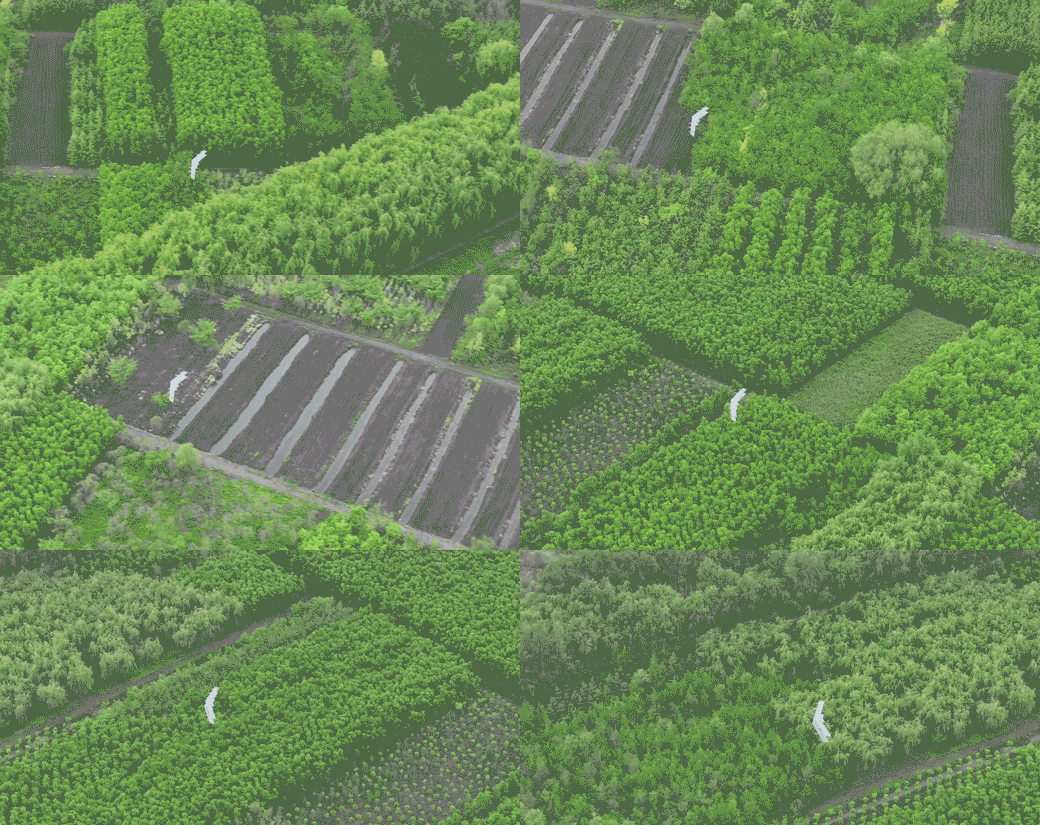
For large-scale disasters—mountain ranges, coastlines, forests, or national power grids—that performance gap is decisive.
What makes the best drones with longest range different
Aerodynamic efficiency and dual fixed-wing VTOL design
We don’t simply bolt bigger batteries onto a multirotor. Our platforms start from a dual-wing fixed-wing layout combined with VTOL rotors. The concept is simple:
Vertical props handle takeoff and landing in tight spaces.
Fixed wings take over in forward flight for high lift-to-drag efficiency.
That hybrid design lets our aircraft fly 2× longer and carry up to 2× the payload compared with many conventional VTOL hybrids of similar size.
In SAR terms, that means:
covering more valleys in one sortie,
staying overhead while ground teams move, and
keeping a sensor on target for as long as the operation requires.
Power systems, data links, and BVLOS performance
To serve as true long-range SAR platforms, drones need both endurance and reliable communications. On bxuav.cc you’ll see that our TW-series airframes (MTOW from 7–200 kg, payloads from 1–50 kg) are matched to:
High-capacity electric or hybrid powertrains, optimized for specific aircraft sizes.
Robust control and data links with up to 100 km range depending on antenna, link budget, and relay setup.
RTK-grade positioning (centimeter-level) for accurate geotagging of victims, hazards, or damage.
These capabilities are designed for BVLOS (beyond visual line of sight) missions, where ground crews may be tens of kilometers away from the search zone but still need precise situational awareness.
Safety, redundancy, and mission reliability
In emergency work, losing a drone is more than hardware loss—it can break situational awareness at a critical moment. That’s why our systems layer safety features such as:
Automatic return-to-home on signal loss or low battery.
GNSS anomaly handling and smart geofencing.
Rapid self-check routines, typically completed in about two minutes before takeoff.
The goal is to behave more like a professional airframe than a hobby drone: predictable, auditable, and ready to integrate into structured SAR workflows.
Dual fixed-wing VTOL: the SAR sweet spot
VTOL launch, fixed-wing cruise: solving real-world constraints
Imagine a landslide in a narrow valley, or a flash flood in a remote village:
No runway, limited road access.
Power lines, trees, and unstable slopes everywhere.
With dual fixed-wing VTOL, SAR teams can:
Take off vertically from a small roadside, field edge, truck bed, or village square.
Transition to wing-borne flight and climb quickly to search altitude.
Cruise efficiently across multiple valleys, ridgelines, and coastal sectors.
Return and land vertically at the same compact spot.
This combination is exactly why dual fixed-wing VTOL platforms appear repeatedly in our industrial application pages—emergency response, long-range monitoring, and large-area inspections all benefit from the same launch-anywhere, fly-far profile.
Handling mountains, coastlines, and harsh weather
Our airframes are built around full-vector control and wind-adaptive stability, validated by extensive deployments in energy inspection, border patrol, and emergency support.
In SAR practice, that means:
more stable EO/IR imagery in gusty conditions,
safer paths along ridgelines where wind shear is common,
reliable cruise even in strong winds, where many multirotors have to stay grounded.
For coastal SAR, stable long-range imaging is the difference between “something blurry on the water” and a clear classification: person, boat, or debris line.
Inside CHANG CHUN CHANG GUANG BO XIANG UAV Co., Ltd.
From research institute to industry-grade manufacturer
CHANG CHUN CHANG GUANG BO XIANG UAV Co., Ltd. originated from the UAV division of the Chinese Academy of Sciences (2009) and transitioned into an innovation-driven enterprise in 2021.
That background matters for SAR buyers because it shapes our priorities:
Aerospace-level design and verification rather than hobby-style prototyping.
Industrial production and quality systems (e.g., ISO9001/GJB9001C certifications).
A product roadmap focused on dual-use applications: civil plus defense, day-to-day plus emergency.
The company is recognized as a “Specialized, Refined, Distinctive, and Innovative” enterprise in Jilin Province and functions as a provincial-level national economic mobilization unit—meaning our platforms are part of formal emergency preparedness planning, not just commercial catalog items.
Dual-use platforms for national emergencies
Because the same TW-series aircraft fly power line inspection, mapping, logistics, and security patrols, they can be quickly repurposed for:
disaster reconnaissance,
wildfire monitoring,
large-scale flood response,
border and coastal SAR.
For governments and integrators, standardizing on a single family of long-range VTOL platforms simplifies training, logistics, and lifecycle support.
BOXIANG fixed-wing VTOL platform overview for SAR teams
Endurance, range, and coverage
Across the TW-series, you can configure aircraft to match different SAR levels:
Endurance: roughly 2 h 10 min up to 8 h unladen, depending on model.
Endurance with EO/IR gimbal: typically 1 h 40 min to 7.5 h.
Cruise speed: about 60–90 km/h.
Control / communication range:
15–35 km for compact models,
up to 50–100 km for larger systems with enhanced links.
For SAR planners, this translates into tens of thousands of hectares of coverage per single mission when combined with high-zoom payloads and optimized search patterns.
MTOW and payload flexibility
The TW-series covers use cases from backpack deployment to heavy-lift missions:
Wingspan: roughly 1.5–6 m class.
MTOW: from about 7 kg up to 200 kg.
Payload: from 1 kg on small airframes up to 50 kg on the largest platforms.
This lets agencies mix:
compact, foot-mobile systems for local SAR,
mid-size aircraft for regional teams,
heavy platforms for national-level command centers, where persistence and payload diversity matter more than portability.
Communication, altitude, and environment
Our fixed-wing VTOL UAVs are designed to fly high enough to “see over” obstacles while maintaining precise positioning:
Service ceiling: up to ~5500 m (model-dependent).
Multi-constellation GNSS: GPS, GLONASS, BeiDou, Galileo, plus RTK-level accuracy.
Operating temperature: –20°C to +65°C; light-rain capable.
From winter mountain rescues and desert patrols to humid coastal storms, the same fleet can support very different climates.
Matching TW-series airframes to SAR roles
While the exact model list evolves, the typical role split looks like this:
TW 08 Mini / Pro – ultralight, backpack-ready units for patrols on foot or small vehicles; ideal when you have to hike to the launch point.
TW 12 / TW 25 – mid-size workhorses for county or regional SAR teams that need balance between portability, range, and payload.
TW 50 / TW 200 – heavy dual fixed-wing VTOL platforms for national agencies, suited to long-duration overwatch, multi-sensor payloads, and cargo or communication relay missions.
The key is that all of them are part of the same technical ecosystem, share similar operating logic, and use standardized payload interfaces.
Payloads that turn platforms into lifesaving tools
EO/IR gimbals for day–night detection
For SAR, the most common request is straightforward: “We need to see people, day or night, in difficult terrain.”
Our modular EO/IR gimbal family (e.g., 120× and 240× dual or tri-sensor payloads) is built around:
high-resolution visible cameras,
thermal imaging (e.g., 640×512), and
powerful hybrid zoom (up to 120×–240× hybrid) for standoff identification.
Thermal channels are crucial for:
spotting warm bodies against cold ground or water,
identifying hidden hot spots in wildfires,
looking through smoke or light fog when RGB cameras struggle.
Tri-sensor pods, laser ranging, and precise geolocation
Tri-sensor payloads such as P3-120x / P3-240x combine:
visible imaging,
thermal infrared, and
laser rangefinding (typical ranges 5–1500 m or 50–3000 m, model-dependent).
Once the operator designates a target, the system outputs:
accurate slant range,
precise latitude/longitude,
elevation and time tags.
For SAR, this means you don’t just see a heat spot—you can drop exact coordinates into GIS, send them to ground teams, and record them in the mission log.
Mapping, LiDAR, and multispectral options
Post-disaster, SAR teams often transition into damage assessment and reconstruction planning. Our payload ecosystem (as shown on bxuav.cc) includes:
Full-frame nadir cameras for high-resolution orthophotos.
Oblique camera arrays for dense 3D models of landslides, collapsed structures, or floodplains.
LiDAR modules with long range and high point density for terrain and vegetation structure.
Multispectral sensors for flood impact analysis, vegetation stress, and environmental monitoring.
Communication relay and voice/lighting modules for crowd control, guidance, or temporary network restoration.
Quick-release mounts allow teams to switch from night search to mapping or communication relay in the same operational day.
How the best drones with longest range reshape SAR workflows
Rapid situation assessment and command support
Within minutes of arriving at a scene, a dual fixed-wing VTOL UAV can be airborne, streaming live EO/IR feeds to a command vehicle or regional center. Incident command can immediately see:
blocked roads, bridges, and evacuation routes,
flooded zones and potential helicopter landing areas,
fire lines and likely spread directions,
which sectors have already been covered and which remain unsearched.
This top-down view avoids sending teams blindly into dangerous areas and helps prioritize scarce resources.
Wide-area search, tracking, and confirmation
Once planners define the rough search sector, long-range drones can:
fly structured search patterns over mountains, forests, or coastlines,
use thermal and high-zoom channels to spot potential victims,
mark each candidate with coordinates and time stamps,
maintain overwatch while ground teams move in for extraction.
Instead of returning every half hour for a battery swap, the best drones with longest range stay aloft long enough to cover multiple villages or valleys in a single sortie.
Delivery, relay, and persistent overwatch
Larger TW-series platforms can also support:
delivery of small medical kits, water, or survival gear to stranded people,
temporary communication relay, bridging field teams and command centers when ground networks are down,
continuous night overwatch, tracking evacuation routes, fire fronts, water levels, or crowd flows.
This turns the UAV from a “flying camera” into a multi-role emergency asset.
Training and operations: getting full value from long-range UAVs
Technology only helps if teams can use it confidently under pressure. For SAR customers, we usually recommend training packages that cover:
Long-range mission planning – search patterns, altitude selection, comms planning, BVLOS procedures.
Multi-payload workflows – switching between EO/IR, mapping, LiDAR, and relay modes.
Emergency procedures – GNSS anomalies, link loss, sudden weather changes, lost-link recovery.
Data integration – feeding UAV data into existing GIS platforms and incident command systems.
Because our dual fixed-wing VTOL UAVs share a common design philosophy across sizes, pilots who learn on one TW-series aircraft can transition to others quickly.
Operational advantages for agencies and integrators
Deployment and logistics in the field
BOXIANG fixed-wing VTOL UAVs are designed for fast deployment:
quick assembly and disassembly,
fast battery or power module swaps,
compact transport cases from backpack to light truck.
Agencies can pre-position airframes at regional depots, fire stations, or border posts, ready for both everyday tasks and sudden large-scale incidents.
Reliability data and lifecycle cost
For long-range UAV fleets, total cost of ownership matters more than the upfront price tag. Our focus on:
dual-wing aerodynamics,
industrial-grade components, and
vector-controlled flight
helps reduce unplanned downtime, minimize field failures, and avoid training fragmentation across too many incompatible platforms.
For integrators, standardized payload buses and interfaces simplify adding national communication systems, custom sensors, or country-specific encryption.
Future directions: swarms, autonomy, and data fusion
Multi-UAV collaboration and relay chains
Our fixed-wing VTOL platforms already support relay communication and multi-UAV collaboration in so-called “triple-disruption” environments—where power, signal, and network are all under stress.
Looking ahead, this enables:
swarm search patterns, splitting a disaster zone across multiple aircraft,
dynamic relay chains, extending communication far beyond a single link,
autonomous handovers, where one UAV replaces another over a hotspot without gaps in coverage.
Integrating aerial data into SAR command platforms
As SAR operations become more data-driven, the best drones with longest range will be expected to:
stream EO/IR, LiDAR, and multispectral data directly into live maps,
feed AI-based analytics that highlight people, vehicles, fire lines, or water boundaries automatically,
synchronize with ground sensors and satellites for a unified operational picture.
Given our roots in high-precision imaging and dual fixed-wing VTOL engineering, we aim to be a core supplier in this future SAR ecosystem.
FAQs
FAQ 1: How far can BOXIANG fixed-wing VTOL UAVs realistically fly in a SAR mission?
Depending on the model and payload, endurance ranges from about 2 hours on compact platforms up to 8 hours unladen on our largest systems, with 1 h 40 min to 7.5 h typical when carrying standard EO/IR payloads. With cruise speeds around 60–90 km/h and control ranges up to 100 km, a single mission can cover very large search sectors.
FAQ 2: Can these UAVs operate safely in strong winds or bad weather?
Yes. Our dual fixed-wing VTOL UAVs are built for strong wind resistance (up to around Beaufort 7–8 in cruise), operate from –20°C to +65°C, and are rated for light rain. The dual-wing layout, full-vector control, and adaptive stabilization help keep imagery stable and flight paths reliable when conditions are challenging.
FAQ 3: Which payloads are most useful for SAR?
For search and rescue, EO/IR gimbals with thermal imaging and high zoom (120× or 240× hybrid) are usually the first choice. Tri-sensor units add laser ranging for precise victim or hazard geolocation. For post-incident assessment, full-frame cameras, oblique camera arrays, and LiDAR modules are extremely valuable for building detailed 3D maps and damage models.
FAQ 4: How portable are the systems in the field?
Smaller TW-series platforms are designed for backpack carry. Mid-sized units fit in SUVs or pickups, while larger systems travel in light-duty trucks. Assembly, self-check, and launch are streamlined so that teams can get airborne within minutes from improvised field bases.
FAQ 5: Can agencies integrate their own sensors or communication equipment?
Yes. The BOXIANG ecosystem is built around modular, quick-release payload interfaces. In addition to standard EO/IR, LiDAR, and multispectral payloads, we support communication relays, lighting, and voice broadcast modules—and integrators can work with us to add custom payloads tailored to national or regional SAR requirements.