Drone Inspection Benefits for Industry: From Safety to Smarter Data
Industrial inspection is often slow, costly, and risky. A tower may be too high to climb safely. A pipeline may cross remote land. A power line may run through forests, rivers, and mountains. For many industrial teams, the hardest part is not finding the problem. It is getting close enough to see it.
Drones are changing that process.
They do not replace every inspector or technician. Instead, they give teams a safer and faster way to check difficult areas before sending people on site. For industries that manage large assets, drone inspection can reduce risk, improve efficiency, and turn field observations into useful maintenance data.
What drone inspection benefits for industry really mean
When people talk about drone inspection benefits for industry, they usually care about practical results: safer access, faster inspection, clearer evidence, and better decisions.
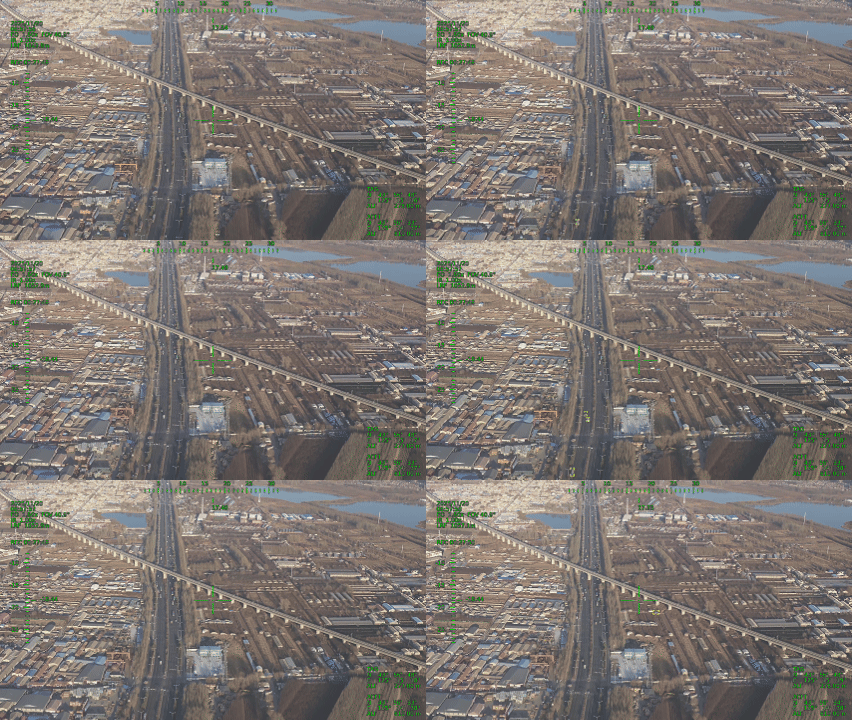
A drone can fly near hard-to-reach assets, collect high-resolution images, record thermal data, create maps, or scan terrain with LiDAR. Compared with manual inspection, the biggest change is simple: teams can see more before they risk more.
Safer inspection before manual work
Safety is one of the strongest reasons to use drones in industry.
A UAV can inspect a transmission tower before a worker climbs it. It can check a pipeline route before a ground crew is sent out. It can view a damaged area after a flood, fire, or landslide before emergency teams move closer.
This does not remove people from the job. It helps them enter the job with better information.
Better data, not just more photos
A drone flight should not end with a folder full of random images. Good inspection needs organized data.
Images can show corrosion, cracks, loose parts, leakage signs, damaged insulation, or vegetation risks. Infrared cameras can reveal abnormal heat. Mapping cameras and LiDAR can support models, measurements, and long-term comparison.
When this data is collected regularly, teams can see whether a problem is new, growing, or stable.
Why traditional inspection can slow down industrial work
Manual inspection often requires a long setup process. Teams may need scaffolding, cranes, rope access, safety approvals, road access, shutdown windows, or special vehicles. If the weather changes, the schedule may fall apart.
For large industrial assets, this process can become heavier than expected.
A drone can complete the first check quickly and help teams decide where manual inspection is truly needed.
Less downtime and fewer access problems
Downtime is expensive. In power, oil and gas, mining, water conservancy, and manufacturing, stopping equipment is not a small decision.
Drone inspection can often be done with less interruption. The UAV collects data first, and maintenance teams review the findings before planning repairs. This can reduce unnecessary shutdowns and make the repair process more targeted.
Faster coverage over large sites
Some assets are simply too large for slow manual checks. Power corridors, pipelines, forests, reservoirs, dams, and industrial parks can take a long time to inspect from the ground.
Drones help teams cover more area in less time, especially when the mission involves long distances or difficult terrain.
drone inspection benefits for industry in harsh environments
Industrial inspection rarely happens in perfect conditions. Sites may be windy, dusty, wet, remote, or difficult to access. A simple camera drone may not be enough.
The UAV must have stable flight performance, useful endurance, payload capacity, and reliable safety functions. Otherwise, the inspection result may not be trusted.
Why endurance and wind resistance matter
Longer endurance means fewer interruptions. Stronger wind resistance means fewer cancelled missions. Better payload capacity means the UAV can carry the right sensor instead of only a basic camera.
For industrial users, these details are not small. They affect whether the mission can be completed in one trip and whether the data is clear enough to support decisions.
Where BOXIANG dual fixed-wing VTOL UAVs fit in
CHANG CHUN CHANG GUANG BO XIANG UAV Co., Ltd. focuses on intelligent UAV research, manufacturing, sales, and service. The company was built on the technological foundation of the UAV Division of the Chinese Academy of Sciences in 2009 and later restructured as an innovation-driven enterprise in 2021.
Its dual fixed-wing VTOL UAVs are designed for endurance, payload capacity, wind resistance, maneuverability, and portability. These features match many industrial inspection needs.
drone inspection benefits for industry with dual fixed-wing VTOL UAVs
A dual fixed-wing VTOL UAV combines two useful advantages.
Like a multirotor drone, it can take off and land vertically, so it does not need a runway. Like a fixed-wing aircraft, it can fly more efficiently over long distances.
This makes it suitable for power line inspection, pipeline patrol, mapping, forestry, water conservancy, emergency response, and other wide-area missions.
Flexible payloads for different inspection tasks
Industrial inspection is not one single job. A power line task may need zoom and infrared imaging. A mapping project may need a survey camera. A terrain mission may need LiDAR. An emergency response team may need lighting, communication relay, or voice broadcasting.
BOXIANG UAV supports multiple payload options, helping users match the UAV to the mission instead of forcing one camera to do every job.
Common industrial use cases
Drones are useful wherever assets are large, remote, tall, or risky to access. The table below shows common industrial scenarios.
Power and utility inspection
Power inspection is one of the strongest applications for industrial drones. UAVs can inspect transmission lines, towers, substations, insulators, and vegetation near power corridors.
With zoom and infrared payloads, teams can check risky areas from a safer distance and find problems earlier.
Pipeline patrol
Pipelines often pass through remote or rough land. UAVs can patrol routes, record changes, and help teams locate areas that need closer ground inspection.
For long-distance patrol, fixed-wing VTOL UAVs are especially useful because they can cover wider areas more efficiently.
Water conservancy and environmental monitoring
Drones can support dam inspection, reservoir monitoring, river patrol, flood assessment, and terrain mapping. With the right sensor, they can collect useful data for both inspection and planning.
Emergency response
After fires, floods, landslides, or industrial accidents, teams need information quickly. UAVs can provide aerial views, thermal images, lighting support, or communication relay before people enter the danger area.
How to choose the right drone inspection platform
The best drone is not always the biggest one. It is the one that fits the job.
Before choosing a UAV, companies should ask:
Flight time is important, but it is not enough. Payload capacity, wind resistance, positioning accuracy, portability, safety functions, and after-sales support also matter.
A good industrial UAV should help the team complete the mission, not create another problem in the field.
Conclusion
Drone inspection gives industrial teams a safer and smarter way to work. It helps reduce risky manual access, speeds up large-area checks, improves inspection records, and supports better maintenance decisions.
For industries that manage power lines, pipelines, water projects, forests, emergency sites, or large infrastructure, UAVs are becoming practical inspection tools.
With dual fixed-wing VTOL design, strong endurance, payload flexibility, wind resistance, and field-ready portability, BOXIANG UAV offers a solid option for industrial users who need more than a basic aerial camera.
FAQs
1. What are the main drone inspection benefits for industry?
The main benefits include safer access, faster inspection, better data records, reduced downtime, and clearer maintenance evidence.
2. Why use a fixed-wing VTOL UAV for inspection?
A fixed-wing VTOL UAV can take off vertically without a runway and fly efficiently over longer distances, making it useful for wide-area industrial missions.
3. What payloads are useful for drone inspection?
Common payloads include zoom cameras, infrared cameras, mapping cameras, laser ranging systems, multispectral sensors, and LiDAR.
4. Can drones replace manual inspection completely?
Not completely. Drones are best for first-pass inspection, monitoring, and data collection. Some repairs and physical checks still need technicians.
5. Why choose BOXIANG UAV for industrial inspection?
BOXIANG UAV offers dual fixed-wing VTOL platforms with endurance, payload flexibility, wind resistance, portability, and support for multiple industrial inspection scenarios.